Peering with Root DNS Servers
The Domain Name System is a recursive system for resolving host names to IP addresses and from IP addresses back to host names, which is really handy, since ideally no one interacts with IP addresses and instead refers to servers by names like google.com or blog.thelifeofkenneth.com.
When you’re resolving a hostname like blog.thelifeofkenneth.com, it’s actually a multi-step process where you first figure out the DNS server for the .com domain, then ask them where the name server for thelifeofkenneth.com is, then you ask them what the address for the “blog” server is. This is a well documented process elsewhere, but what I’m particularly interested in is that first little step where you somehow find the first DNS server; this is done by asking one of the 13 root name servers, which are 13 specific servers (lettered A through M) hard coded into every recursive DNS implementation as a starting point to resolve any other address.
The reason that I’m interested is because I recently became part of the team running the Fremont Cabal Internet Exchange. IXPs often peer with root name servers to make the fabric more valuable since root name servers tend to be really important for the other networks connecting to the IXP. This is possible because many of the root servers aren’t implemented as one enormous DNS server in a specific place like you’d imagine, but are actually many identical copies of the same server advertising the same anycast prefix from every instance.
This means that even though we’re a small IXP in the bay area, we actually stand a chance of an instance of several of the root servers being close by, or being willing to ship us the equipment to host an instance of them. We have spare rack space, so hosting their hardware to be able to increase our value and make the Internet generally better is worth providing them the space and power.
For curiosity’s sake, I’ve been stepping through the list of root DNS servers to try and find what information I can on them, and figured these notes would be useful for some small fraction of other people online.
- A ROOT - Run by Verisign
- Homepage
- Status: Only hosted in six locations; Ashburn, Los Angeles, New York, Frankfurt, London and Tokyo
- B ROOT - Run by University of Southern California, Information Sciences Institute
- Homepage
- Status: Only hosted in Los Angeles and Miami
- C ROOT - Run by Cogent
- Homepage
- Status: Only hosted in 10 locations; LA, Chicago, New York, etc
- D ROOT - Run by University of Maryland
- Homepage
- 136 Sites
- Partially hosted by Woodynet (AS42), which means they're already in FMT2
- E ROOT - Run by NASA Ames Research Center
- Homepage
- Status: 194 sites
- Also partially hosted by Woodynet (AS42), which means they're already in FMT2
- F ROOT - Run by Internet Systems Consortium
- Homepage
- Peering Requirements
- Status: Already happen to be located in HE FMT2
- G ROOT - Run by Defense Information Systems Agency
- Homepage
- Status: Only 6 sites, none in California
- H ROOT - Run by US Army Research Lab
- Homepage
- Status: Only 2 sites; San Diego and Aberdeen
- I ROOT - Run by netnod
- Homepage
- Hosting Requirements: Contact info[at]netnod[dot]se
- Peering Requirements
- Status: 68 sites, including one somewhere in San Francisco
- J ROOT - Run by Verisign
- Homepage
- Requirements include:
- 1U space, 2x power
- 2x network, peering LAN and /29+/64 management interface
- Status: Already somewhere in San Francisco
- K ROOT - Run by RIPE
- Homepage
- Hosting Requirements include:
- Provide a Dell server with 16GB RAM, quad core, 2x500GB HDD, etc.
- Public IPv6 address with NAT64
- Status: Seems the physically closest one is on TahoeIX in Reno.
- L ROOT - Run by ICANN
- Homepage
- Hosting Requirements:
- Sign NDA
- Purchase code named appliance to host inside own network
- Status: Somewhere in San Jose, per their FAQ they are not joining any additional IXPs.
- M ROOT - Run by WIDE Project
- Homepage
- Status: Somewhere in San Francisco, nine sites total
- Roots that will never be in the bay area: A, B, C, G, H
- Roots already in the bay area: D, E, F, I, J, L, M
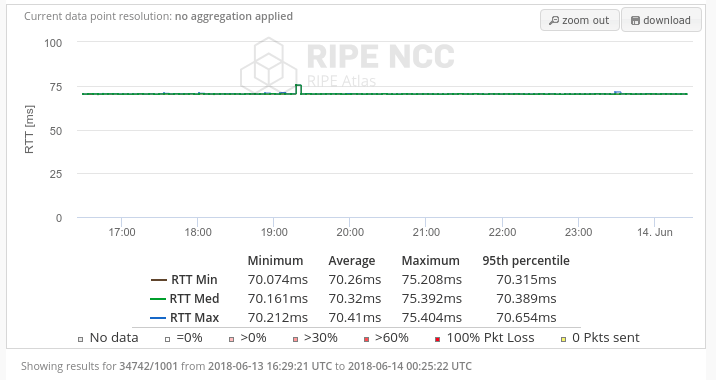
- They're a fantastic example of another tiny IXP who has done a remarkably good job of collecting value-add peers to their network; Verisign, PCH/WoodyNet, Akamai, AS112, K root, and F root.
- Hurricane Electric is in "provisioning" with them, so presumably at some point soon, HE will have access to K root from Tahoe, dropping its latency to the bay area quite a bit.